
Details
The article 000002161 shows FindLine's angular accuracy against rotational drift with the consideration of line’s contrast.
While this article tries to show the performance of LineMax in the same manner with the same synthetic line dataset used in the article 000002161. Since all the synthetic line generation related details are described in the article 000002161, this article is focused on explaining the difference in performance between LineMax and FindLine.
Here are the parameters set for LineMax, and all its parameters remain the same during the whole process of performance evaluation. Like FindLine, LineMax's parameters are set to find the line with the polarity from dark to light.
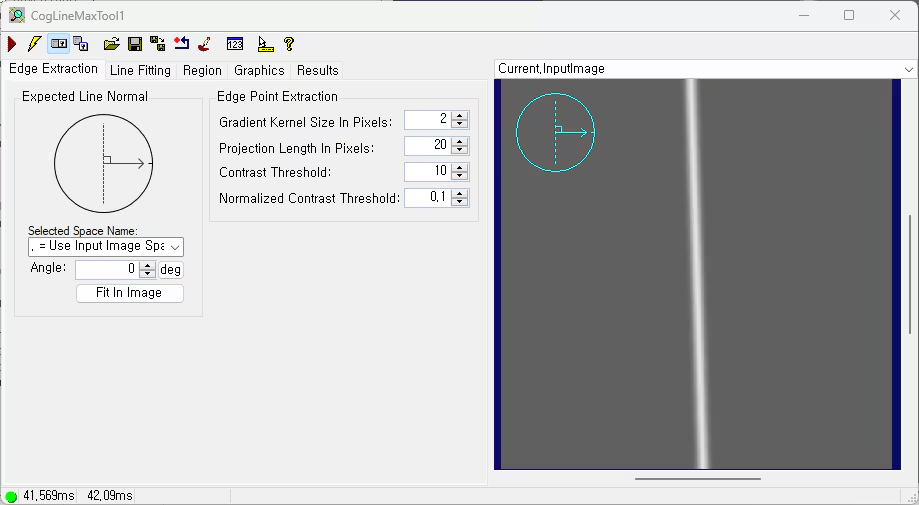
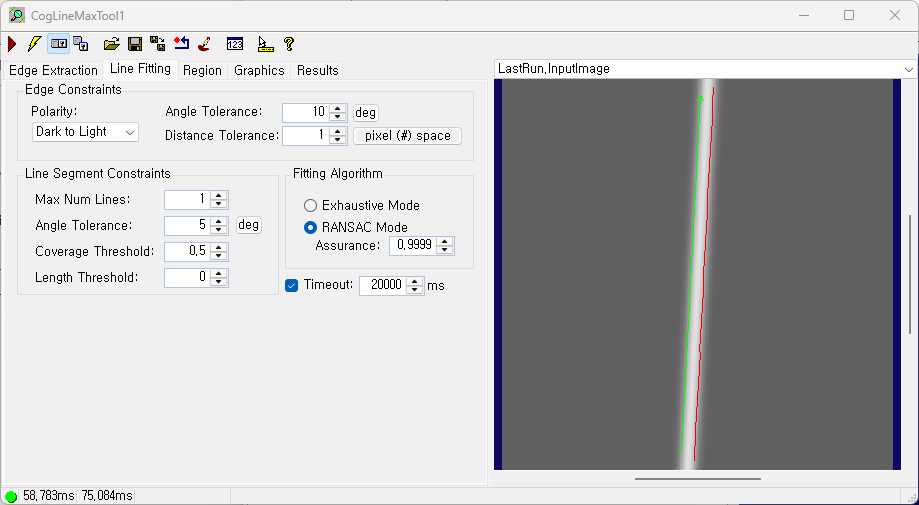
The following figures show the comparison of angular accuracy between FindLine and LineMax.
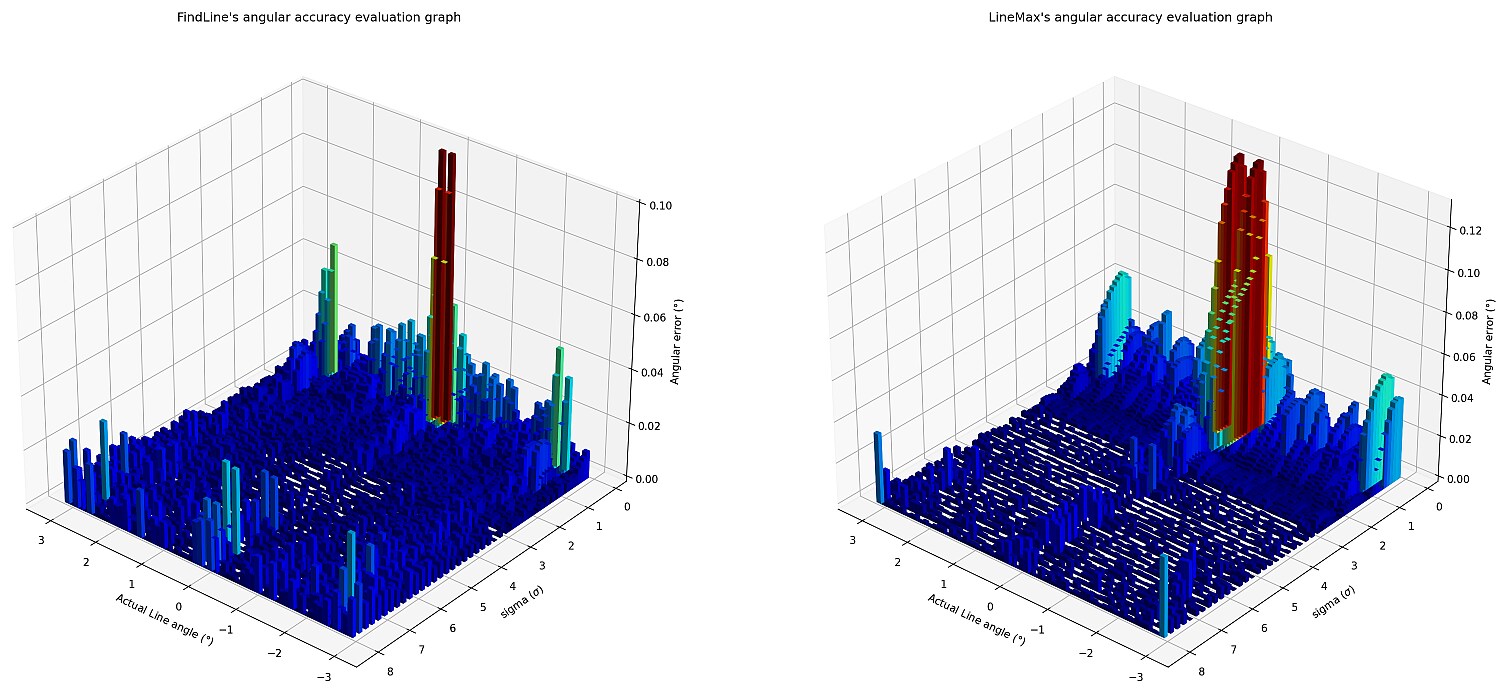
Front view of comparison between FindLine and LineMax (sigma is in ascending order).
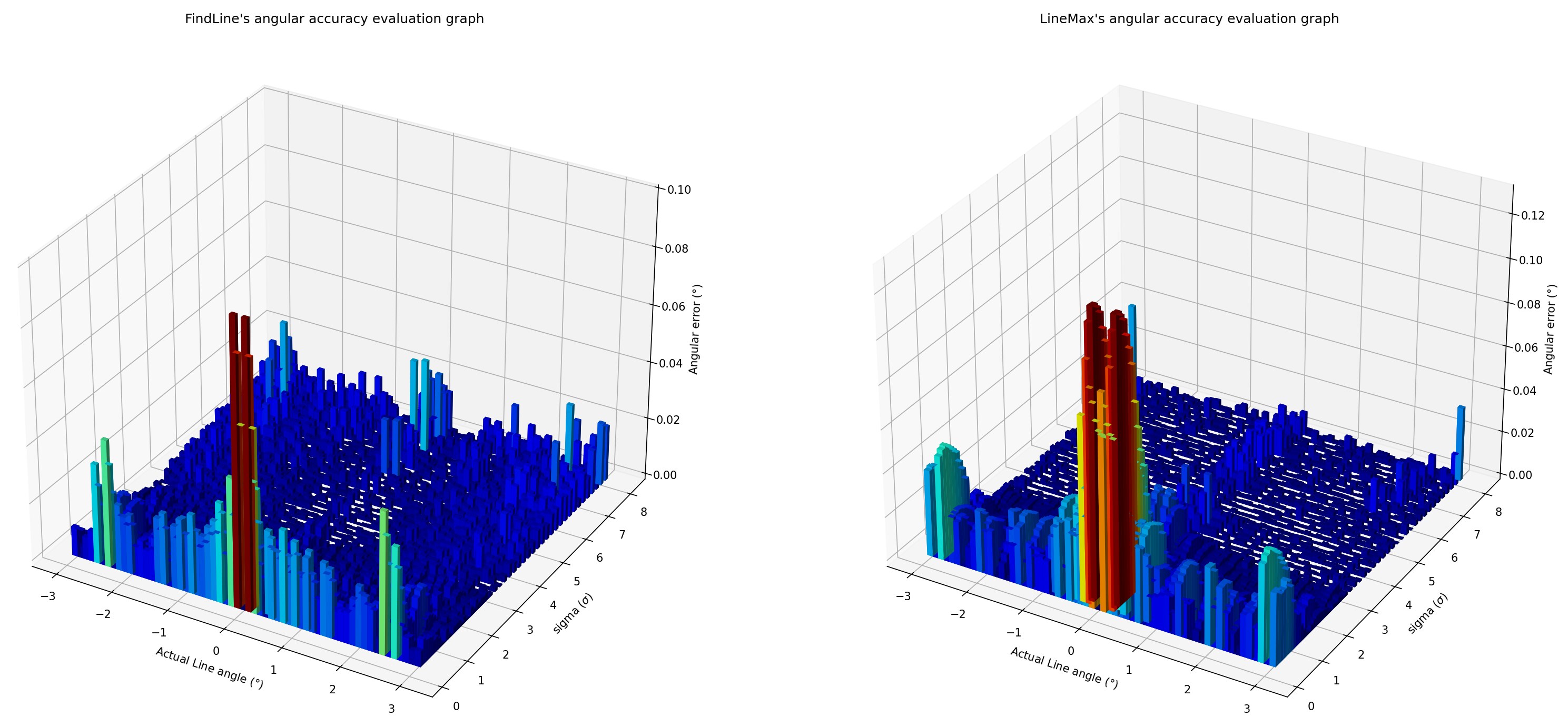
Rear view of comparison between FindLine and LineMax (sigma is in descending order).
From the above 3D bar graphs, two observations can be derived as follows:
- Compared to FindLine, LineMax is more sensitive to the aliasing effect. That's why LineMax showed a bigger fluctuation scale when sigma is very small.
- But after sigma is bigger than 1.0 (which is equivalent to six pixels in line width), LineMax showed better angular accuracy than FindLine and when sigma is larger than 3.0, LineMax’s average angular deviation error is 0.0022, which is about 50% smaller than FindLine’s average angular deviation error of 0.0040.
Conclusion:
- Both FindLine and LineMax are sensitive to severe aliasing effects. Thus, for real application, it's better to avoid making it happen especially when line angle is within the range of [-1, 1 ], else both FindLine's and LineMax's angular accuracy can be dropped due to the triggered aliasing effect. In such a case, making the line be smoother by tuning camera, light, and related parameters can be effective for alleviating the performance drop.
- In the no aliasing effect zone (sigma >= 3.0), LineMax shows evidently higher accuracy than FindLine in most range of line angles and sigma (contrast of line)
Note 1: To view FindLine's performance on angular accuracy, please refer to the article 000002161.
Note2: All the above line finding tool names and tests are valid with VisionPro 9.23.